
How Pinball Machines Work: A Beginner's Overview
Key takeaways
- A pinball machine turns one steel ball, two flipper buttons and a sloped playfield into a scoring game controlled by bumpers, targets, ramps and switches.
- Modern machines run on solid-state electronics, a shift that began in 1977 when Williams converted its production lines and Stern shipped its first solid-state title.
- Scoring comes from hitting switches across the playfield, while modes and multiball reward players who follow the rules built into each game.
- The Internet Pinball Database catalogs more than 6,336 games, making it the fastest way to research any machine before you buy.
- Knowing the parts and eras helps you judge condition, spot missing pieces and pay a fair price for a used table.
A pinball machine launches a steel ball onto a sloped, glass-covered playfield, and your job is to keep it in play using two flippers while it strikes scoring targets. Points come from every bumper, ramp and switch the ball touches before it drains between the flippers. That single loop, launch, hit, score, repeat, is the heart of every machine ever built.
Once you understand how the parts connect, the flashing lights and rapid sounds stop feeling random. This overview of how pinball machines work walks through the anatomy, the scoring, the electronics behind the eras, and the vocabulary you need to shop with confidence.

What are the main parts of a pinball machine?
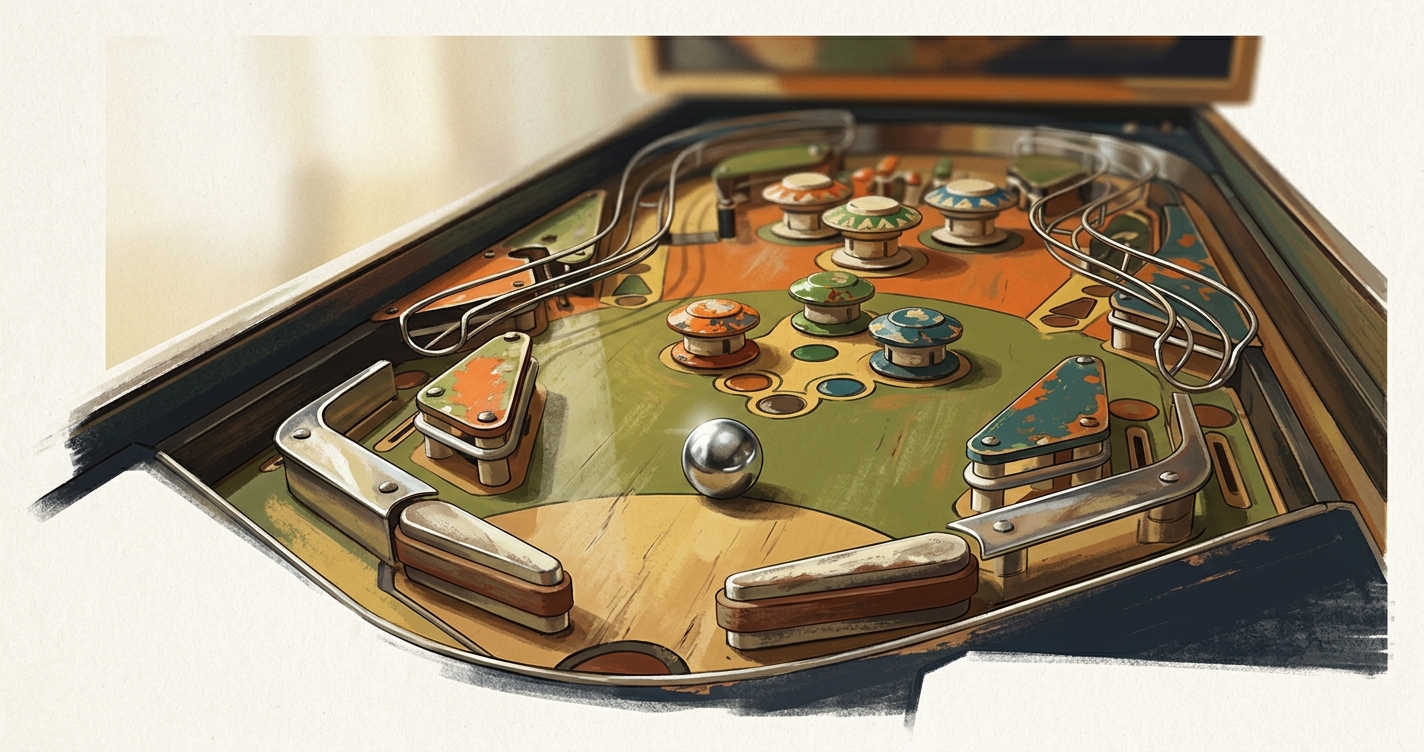
Every pinball machine shares the same core anatomy: a playfield, two flippers, bumpers, targets and a plunger to put the ball in play. The playfield is the angled surface under the glass, and gravity constantly pulls the ball toward the drain at the bottom. Your flippers are the only tools that fight that pull.
The flippers sit at the bottom of the playfield and are controlled by a button on each side of the cabinet. Press a button and the flipper swings up to bat the ball back into play. Bumpers are the round, spring-loaded pieces near the top that kick the ball away on contact, adding points and speed. Targets are stationary switches that score when hit, and ramps send the ball on a raised path back to the flippers or into a scoring lane.
The steepness of the playfield matters more than most beginners expect. Early machines used a gentler slope, while later machines steepened it to speed the ball up. That change made games faster and more demanding, which is part of why modern tables feel so intense.
How do flippers and switches move the ball?
Flippers move the ball using electromagnetic coils, not springs or motors. When you press a flipper button, it closes a switch that sends current to a coil. The coil pulses, snaps the flipper upward against the ball, then releases so a return spring drops the flipper back. This all happens in a fraction of a second.
The rest of the playfield works on the same principle. Nearly every part the ball can touch, a bumper, a rollover lane, a drop target, hides a switch. When the ball trips that switch, the machine registers a hit and awards points. A single game can involve dozens of these switches firing hundreds of times, which is why a busy table produces such a steady stream of chimes and flashes.
Understanding switches also explains a common frustration: a machine that will not score correctly. If a switch is dirty, bent or disconnected, that target simply stops counting. On a used machine, testing that every switch registers is one of the most useful checks a buyer can make.
How does scoring, modes and multiball work?
Scoring in pinball comes from hitting switches, but modern machines layer rules on top that reward specific sequences of shots. Basic points accumulate whenever the ball strikes a scoring element. Beyond that, most solid-state and digital machines add modes, which are timed or objective-based challenges that pay out much larger scores when you complete them.
A mode might ask you to hit three lit ramps in a row or shoot a particular target several times. The machine tracks your progress with lit inserts on the playfield and callouts from the speakers. Completing a mode often builds toward the biggest reward of all: multiball.
Multiball releases two or more balls onto the playfield at the same time. With several balls live, scoring opportunities multiply because you can trigger many switches at once. Multiball usually starts after you lock balls in a specific saucer or hole, and keeping all of them in play is where casual players and serious ones separate. If you are new, focusing on reaching multiball is a satisfying early goal.
What is the difference between mechanical, solid-state and digital systems?
Pinball machines fall into three broad technical eras: electromechanical, solid-state and modern digital. Electromechanical machines, common before the late 1970s, ran on relays, motors and spinning scoring reels. You can often hear them, since the score advances with a distinctive clicking sound and the numbers physically roll over.
The industry shifted to solid-state electronics in 1977. That year Williams converted its production lines to solid-state, and Stern shipped its first solid-state title as well. Circuit boards and microprocessors replaced most of the mechanical scoring hardware, which allowed deeper rules, digital displays and richer sound.
Modern digital machines extend that foundation with color displays, networked scoreboards and elaborate software. The core physics have not changed since Gottlieb's Humpty Dumpty introduced player-controlled flippers on October 25, 1947, a design so effective that flippers became standard on nearly every game within about six months (Betson). What changed is the brain running the game, not the ball and the flippers.
What pinball terms should every new player know?
A handful of terms cover most conversations about how pinball machines work. Learning them makes rules cards, listings and repair guides far easier to follow. Here are the essentials worth memorizing before you play or buy.
- Playfield: the sloped surface under the glass where the game happens.
- Flipper: the paddle you control to bat the ball back into play.
- Bumper: a spring-loaded target that kicks the ball away and scores.
- Drain: the gap between the flippers where a lost ball exits.
- Plunger: the spring-loaded rod that launches the ball to start play.
- Ramp: a raised path that guides the ball to a lane or back to a flipper.
- Mode: a rules-based challenge that rewards a specific sequence of shots.
- Multiball: a state where multiple balls are in play at once.
- Tilt: a penalty triggered when you nudge or shake the machine too hard.
Tilt deserves special attention. Every machine has a tilt sensor, and rocking the cabinet too aggressively ends your ball as a penalty. Gentle nudging to influence the ball is a real skill, but push too far and you lose the ball, so beginners should practice restraint.

Why does understanding the basics help you buy smarter?
Knowing how pinball machines work directly protects your money when buying, especially in the used market. A buyer who understands the parts can test flippers, switches and displays on the spot, rather than trusting a seller's word. That knowledge turns a risky purchase into an informed one.
Era matters for maintenance and value. Electromechanical machines have more mechanical parts that wear, while solid-state machines can develop board-level faults that need electronics knowledge to repair. Neither is automatically better, but each carries different upkeep, and understanding the difference helps you match a machine to your skill and budget. For a full walkthrough of features, condition and pricing, our home pinball machine buying guide covers what to inspect before you commit.
Research is the final safeguard. Before buying any specific title, look it up in the Internet Pinball Database, which catalogs more than 6,336 games along with production details and images (IPDB). Confirming a machine's year, original features and correct parts helps you spot missing components and pay a fair price. At Pinballmachinesinc, that same understanding of anatomy and eras guides how we evaluate and describe every new and used machine we sell.
The best next step is simple: find a machine you like, then inspect its flippers, switches and displays with the vocabulary from this guide in hand. A few minutes of hands-on testing tells you more about a table than any listing photo ever will.
Frequently asked questions
How do pinball flippers actually launch the ball?
Each flipper button triggers a switch that fires an electromagnetic coil. The coil snaps the flipper upward, striking the ball and sending it back up the playfield. Release the button and a spring returns the flipper to rest.
What is multiball in pinball?
Multiball is a mode where the machine releases two or more balls onto the playfield at once. It usually starts after you complete a specific objective, and it multiplies your scoring chances because several balls are live together.
What is the difference between electromechanical and solid-state pinball?
Electromechanical machines use relays, motors and scoring reels to run the game. Solid-state machines, which took over in 1977, use circuit boards and microprocessors for scoring, sound and rules, allowing far more complex play.
Are older pinball machines harder to maintain than new ones?
Older electromechanical machines have more moving mechanical parts that wear out, but their circuits are simpler to trace. Solid-state machines have fewer mechanical failures, though board-level repairs need some electronics knowledge.
Where can I research a specific pinball machine before buying?
The Internet Pinball Database is the standard reference, cataloging more than 6,336 games with production details, images and manufacturer information. It helps you confirm a machine's year, features and original components.
No comment